GS Federal Insights
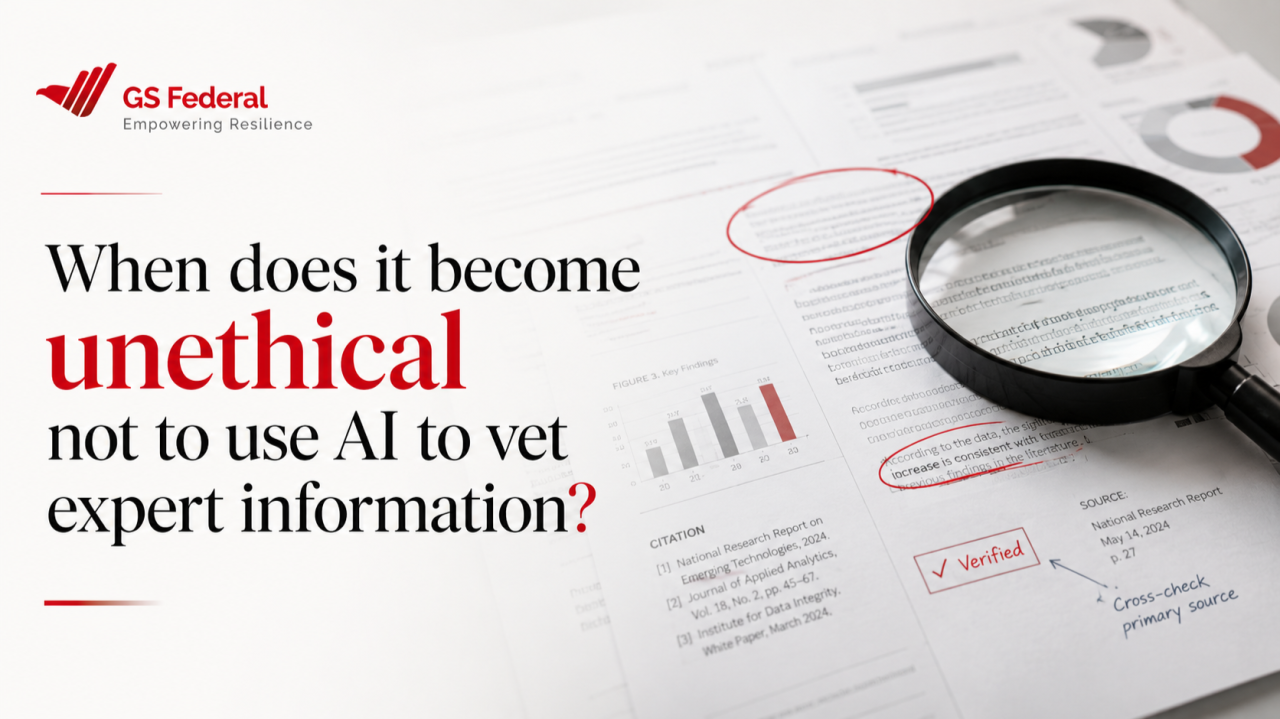
Is It Becoming Unethical Not to Use AI for Expert Review?
AI-assisted review can help catch outdated data, weak sourcing, overstated claims, and unsupported conclusions before expert-created materials reach an audience.
One of the most useful roles I have found for AI is not writing. It is review.
Over the past couple of years, I have reviewed more than 50 presentations and training materials developed by subject-matter experts in prevention, behavioral health, public health, and related fields. I am not going to name the organizations or presenters because the point is not about any one organization, person, or field. The point is about a pattern that has become difficult for me to ignore.
Most of the people creating these materials are legitimate experts. They know their subject matter and have extensive experience. They have spent years working in their fields, and they are not trying to mislead anyone. But expertise does not automatically make a slide deck accurate.
For a long time, I reviewed materials the way many people probably do. I looked for obvious issues. I checked whether the presentation made sense. I reviewed the flow, the framing, the major claims, the audience fit, and the general accuracy of the content. If something seemed questionable, I looked deeper. That process caught some of the problems, but it did not catch nearly enough. I had no idea and often thought I was being too nitpicky.
Over the past year, I started using AI as the first step in my review process. Not to approve anything, not to replace my judgment, and not to make final decisions. I use it as a meticulous first-pass reviewer. I give it structured prompts and ask it to examine claims carefully, identify where sources are missing, flag outdated data, look for overstatements, check whether cited sources actually support the claims being made, and point out places where the presentation may be treating opinion, assumption, or strategy as established fact.
That changed what I could see. What I started finding was not a small problem.
In my own review work prior to using AI, I would find small issues in the majority of presentations, but they were generally grammar or cosmetic. A notable handful would have easily identifiable issues with data or statements of fact. But this was far from the majority of presentations. Since using an AI-assisted review process, I have found significant sourcing, framing, or evidence-interpretation concerns in well over half of the expert-created presentations. This is purely anecdotal based on my experience. However, it is a strong enough pattern that I cannot believe we do not have this issue as a field of practice.
Some of the issues are minor. A statistic is old. A citation needs to be updated. A slide needs more context. A claim needs softer wording. Those are the kinds of issues that can usually be fixed quickly once they are identified.
Other issues are more serious. I have seen outdated data used as if it were current. I have seen data represented in ways that made the finding sound stronger than it was. I have seen citations attached to claims they did not actually support. I have seen strategies presented as proven when the evidence was weak, mixed, or not provided at all. I have seen confident statements across multiple slides that, once reviewed closely, did not hold up.
In some cases, the problem was not one bad slide or one questionable citation. The problem was that unsupported or overstated claims formed part of the foundation of the presentation. That is much harder to fix, and it should concern anyone who works in a field where professional training and public-facing education shape what others believe, repeat, and use.
I do not think most of this happens because people are careless or dishonest. More often, I think it happens because professional materials age in ways that are hard to see.
A slide deck may start out accurate, but then it gets reused. One section gets updated, but another does not. A statistic stays in place because it still looks familiar. A source remains on a slide even though the wording has drifted beyond what that source actually supports. A strategy becomes described as evidence-based because it is widely used, commonly accepted, or has been repeated in the field for years. A presenter may rely on memory because they have taught the topic many times and know the general issue well.
That is understandable. I am not judging these people who are trying to do great work and help communities. But I think people would be shocked at just how much information presented by a speaker may be misleading at best and completely wrong at worst. And it is really, really tough to tell.
In prevention, behavioral health, public health, education, treatment, recovery, and other community-facing work, the field changes quickly. New data come out. Older claims become less certain. Guidance changes. Drug trends shift. Evidence around programs and strategies evolves. What was a reasonable statement several years ago may need to be qualified, updated, or removed. Is our "fact" based on research, or are we passing along something we have heard so many times that everyone accepts it as fact?
The problem is that old information or misinformation does not always look outdated, unreliable, or incomplete when it is inside a polished presentation. It can look finished. It can look credible. It can sound like something everyone already knows. And when the person presenting it is experienced, the information can move through a room with very little resistance.
That is one of the reasons AI-assisted review has been so useful. It does not assume a claim is correct because the deck looks professional or because the presenter is credible. When prompted correctly, it treats each claim as something that needs to be checked.
This has also changed how I think about one of the common assumptions about AI.
AI is often sold as a time-saving tool. In many situations, that is true. It can summarize faster, draft faster, organize faster, compare documents faster, and turn scattered notes into usable language faster than most people can. There are real efficiency gains there.
But that has not been my experience with serious vetting.
Using AI as the first step in the review process often causes me to spend more time, not less. The AI review flags issues I might have passed over. It raises questions about sources. It identifies claims that may be too broad, too certain, or not supported by the citation being used. It points out where a statement may technically be true but still misleading without more context. Once that happens, I have to go deeper. I have to check the source, look at the context, decide whether the AI concern is valid, and then determine whether the slide needs to be changed.
That is not a shortcut. It is a deeper review process.
I think this is an important point for how we talk about responsible AI. If the goal is simply to move faster, AI can make weak work happen more quickly. But if the goal is better quality, AI may slow the process down because it helps reveal problems that deserve attention.
That does not make AI less useful. It may make it more useful.
In high-trust work, speed should not be the only measure. A review process that takes the same amount of time, or even more time, may still be better if it catches inaccurate claims, outdated data, weak citations, or misleading conclusions before they reach an audience. The value is not only efficiency. The value is stronger quality control.
In my experience, AI can be a better first-pass vetter than I am in most ways. Not because it has judgment. Not because it has wisdom. Not because it understands prevention, behavioral health, public health, or community work the way an experienced professional does. It is better in some parts of the process because it is systematic, consistent, and relentless when it is given the right instructions.
A human reviewer may read a slide deck and follow the overall argument. AI can be prompted to slow down and examine each claim. That kind of review is hard to do manually, especially when the presentation is long, the topic is familiar or unfamiliar, the presenter is credible, and the materials are polished, professional, and confident. Human reviewers bring context, experience, and judgment, but we also bring fatigue, assumptions, time pressure, and familiarity with the field's common language. Sometimes that familiarity helps. Sometimes it makes weak claims harder to see.
AI does not solve that problem by itself, but it changes the review process. I do not treat AI's findings as conclusions. I treat them as flags. A flag means, "This needs a closer look." Sometimes the AI is right. Sometimes it is partly right. Sometimes it is wrong, though in my experience it is more often overly nitpicky than completely wrong. But even when it is wrong, the process often improves the review because it forces me to check what the material is actually claiming and what the sources actually support. AI learns from this also.
This is where the ethical question starts to change.
For a long time, the responsible AI question has been framed mostly as, "Is it safe to use AI?" That is still a valid question. AI can be wrong. It can overstate. It can miss context. It can invent sources. It can sound more certain than it should. Those risks are real, and they are exactly why human review and final accountability still matter.
But once AI-assisted review can consistently identify problems that might otherwise move into professional trainings and communication, we also have to ask: when does it become irresponsible not to use it?
That question may make people uncomfortable, but I think it is becoming harder to avoid. If we know a tool can help catch outdated data, unsupported claims, weak citations, overstated conclusions, and strategies presented as proven without adequate evidence, then choosing not to use that tool is not automatically the safer or more responsible position.
In high-trust fields, the standard should not be "the expert probably knows." The standard should be "the claims were checked."
That does not mean every slide deck needs a full academic review. A short internal briefing does not need the same level of scrutiny as a statewide training, a public-facing health explainer, or a youth prevention curriculum. But when materials are being used to educate professionals, guide communities, shape public understanding, or influence practice, the review process needs to be stronger than trust in the presenter's expertise.
Expertise matters. It matters a lot. But expertise should not exempt information from verification. If anything, expert-created materials may need careful review precisely because people are more likely to trust them.
This is also why I think we need to be careful about how we define responsible AI use. Responsible AI is not only about preventing AI from creating bad information. It is also about using AI to help identify bad information that already exists in human-created materials.
Irresponsible non-use.
That may be uncomfortable, but it is important. Human-generated misinformation, outdated information, and overstated expert claims existed before AI. They are not new. What is new is that we now have tools that can help us review large amounts of material more systematically than most humans can do on their own.
Verification is the standard. The standard should be whether the claims can be checked and whether the evidence actually supports what is being said. We sit in a new era where we can really get almost all the facts right. Are we doing well now? Sure. Can we do a lot better? Absolutely.
That is why AI-assisted review may become one of the most important practical uses of AI in high-trust fields. Not because it replaces expertise, but because it can challenge expertise to be more careful. Not because it eliminates human review, but because it can make human review better. Not because it always saves time, but because it can reveal problems that deserve more time.
If AI can help us verify more carefully, then responsible use may not be optional for much longer.
Originally published by Greg Pliler on LinkedIn on July 16, 2026. View the original LinkedIn post.