GS Federal Insights
When AI Stands Between the Expert and the Audience
As AI systems increasingly find, filter, and summarize public information, prevention and public health communication has to be built for both people and machine-mediated discovery.
Most organizations still think about online communication as if it moves in a straight line. An expert, agency, coalition, or organization publishes something. A person searches for it, finds it, reads it, and uses it.
That model is becoming less accurate.
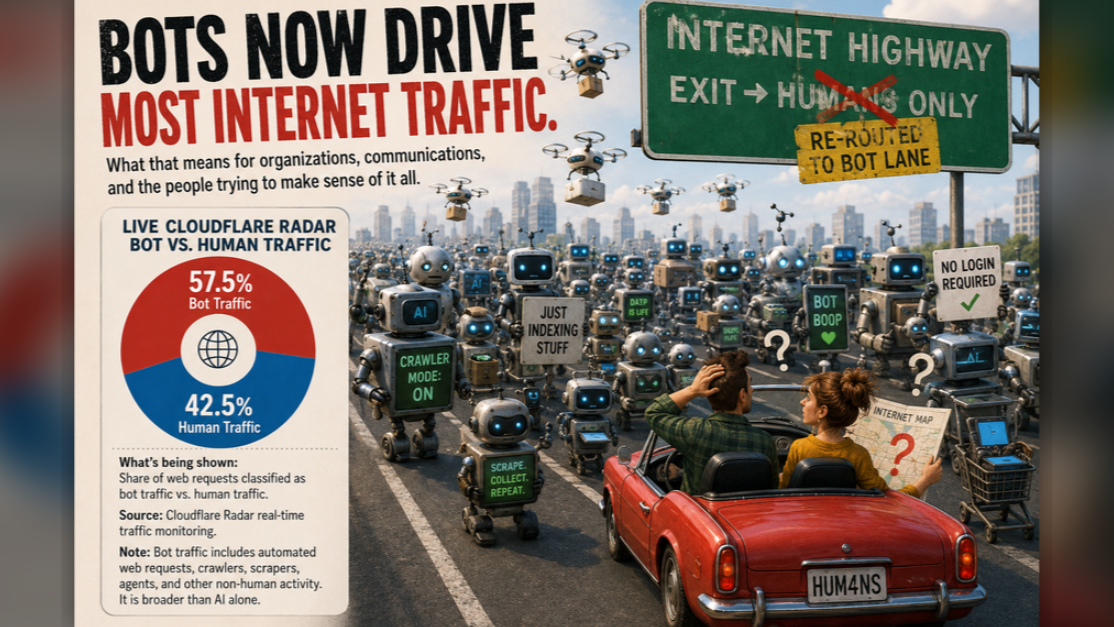
Recent reporting on Cloudflare Radar data suggests that automated bot traffic has now passed human traffic for web page requests. The reported split was roughly 57.5% automated traffic compared with 42.5% human traffic for HTTP requests to HTML pages. That does not mean people have stopped using the internet. It does not include every app, streaming platform, private system, or meaningful human interaction online. But it is still an important signal. More of the web is being accessed, scanned, retrieved, summarized, and filtered by machines before a person ever sees the original source.
That should matter to any field that depends on accurate public information. It should especially matter to those working in the public health space.
The field already operate in a difficult information environment. Professionals are expected to keep up with fentanyl, counterfeit pills, opioid-involved polysubstance use, emerging substances, changing guidance, misinformation, limited staffing, reporting requirements, and community questions. They also have to translate complex information into language that is useful for parents, schools, coalitions, policymakers, community organizations, and frontline workers.
Now another layer is being added. Increasingly, the person reading the information may not be the first "reader." An AI system may have already found the material, ranked it, compared it to other sources, summarized it, shortened it, or used it to answer a question without sending the person back to the original page.
That changes the communication problem.
The old question was: how do we explain this clearly to people?
That question still matters. But it is no longer enough.
The new question may be: how do we make sure accurate human expertise survives being filtered through AI systems?
This is not just a technology issue. It is a communication issue. It is a trust issue. It is a workforce issue. A prevention organization may publish a fact sheet for parents. A public health agency may publish guidance for schools. A coalition may post information about fentanyl, naloxone, counterfeit pills, or emerging drug trends. In the past, success often meant that the right person found the page and read it. In an AI-mediated information environment, success may also depend on whether an AI system can correctly interpret the page, preserve the meaning, identify the source, understand the date, avoid stripping out important cautions, and summarize the material without distorting it.
That is an absolutely different kind of communication challenge that most of us focused on substance misuse prevention haven't even considered.
Recent research has started describing this as movement toward an "agent-first web." A June 2026 paper argues that the web was built around a long-standing assumption: the primary consumer of web content is a human being. The authors argue that this assumption is being disrupted as AI agents become intermediaries between people and web content.
That does not mean every organization needs to rebuild its website around AI agents. It does mean that fields built around trust and accuracy need to pay attention. If more people receive information through AI-generated summaries, then it will not be enough to publish accurate information somewhere on a website and assume the message will travel intact.
Information may need to be written and organized so that both people and machines can understand it. That does not mean manipulative search-engine tactics. It means basic communication discipline: clear titles, clear dates, clear definitions, clear source links, plain-language summaries, structured headings, explicit limits, and direct statements about what the information does and does not mean.
For prevention and public health work, this matters because context matters. A technically accurate statement can still become misleading if it is pulled away from its limits. A summary can sound confident while leaving out uncertainty. A plain-language answer can be useful, but it can also flatten important distinctions. AI tools can make information easier to access, but they can also create false confidence if people assume a polished answer is the same thing as a verified answer.
This is where workforce capacity becomes important.
The next gap may not be whether an organization has access to AI. Many professionals can already open ChatGPT, Copilot, Gemini, Claude, or another tool. Access is becoming less of a dividing line. The more important gap is whether people know how to use AI well.
KPMG's Q2 2026 AI Quarterly Pulse Survey framed this directly: the advantage is no longer simply access to AI; it is the ability to use it well. KPMG connects that advantage to workforce fluency, skills, collaboration, and measurable outcomes.
That point is especially important in high-trust fields. AI fluency cannot just mean knowing how to write a better prompt. In the public health space, AI fluency has to include judgment.
It has to include knowing when AI is useful and when it is not. It has to include source verification, privacy protection, human review, audience adaptation, uncertainty tracking, and the ability to recognize when an answer sounds better or more confident than it actually is. It also has to include knowing how AI systems may read and represent the information an organization publishes.
That last part may become one of the more important pieces.
Responsible AI use is not only about how staff use AI inside an organization. It is also about how the organization's information moves through an AI-shaped information environment. If AI systems increasingly summarize public resources, then the original resources need to be built in ways that reduce the risk of being misunderstood or misrepresented.
That means organizations may need to think differently about how they publish information. A resource should not only be accurate. It should be easy to verify. It should show where claims came from. It should make dates visible. It should separate evidence from interpretation. It should make uncertainty clear. It should avoid burying the main point under vague language. It should give both a human reader and a machine reader enough structure to understand the meaning.
None of this removes the need for human expertise. It increases the need for it.
AI may be able to draft faster, summarize faster, scan faster, and reorganize information faster. But speed is not the same thing as accuracy. In fields where misinformation can affect public trust, professional practice, or community decisions, the human role becomes even more important. The work is not just producing more information. The work is producing information that can survive being searched, summarized, questioned, reused, and adapted
I strongly believe our field as a whole is moving to slowly. Organizations that build responsible AI fluency may be able to respond more quickly to emerging issues, develop better training materials, adapt messages for different audiences, summarize new reports, and reduce the burden of repetitive work. Organizations that do not may still produce good work, but they may be doing every step manually while the information environment accelerates around them.
The goal should not be to replace expertise with AI. The goal should be to protect and extend expertise in an environment where AI is increasingly involved in how information is found, filtered, summarized, and understood.
For prevention, behavioral health, public health, education, treatment, recovery, public safety, and coalition work, the question is no longer whether AI will become part of the information environment. It already is.
The more practical question is this:
What does responsible AI fluency need to include so that accurate human expertise can still reach the people who need it?
Originally published by Greg Pliler on LinkedIn on July 9, 2026. View the original LinkedIn post.